
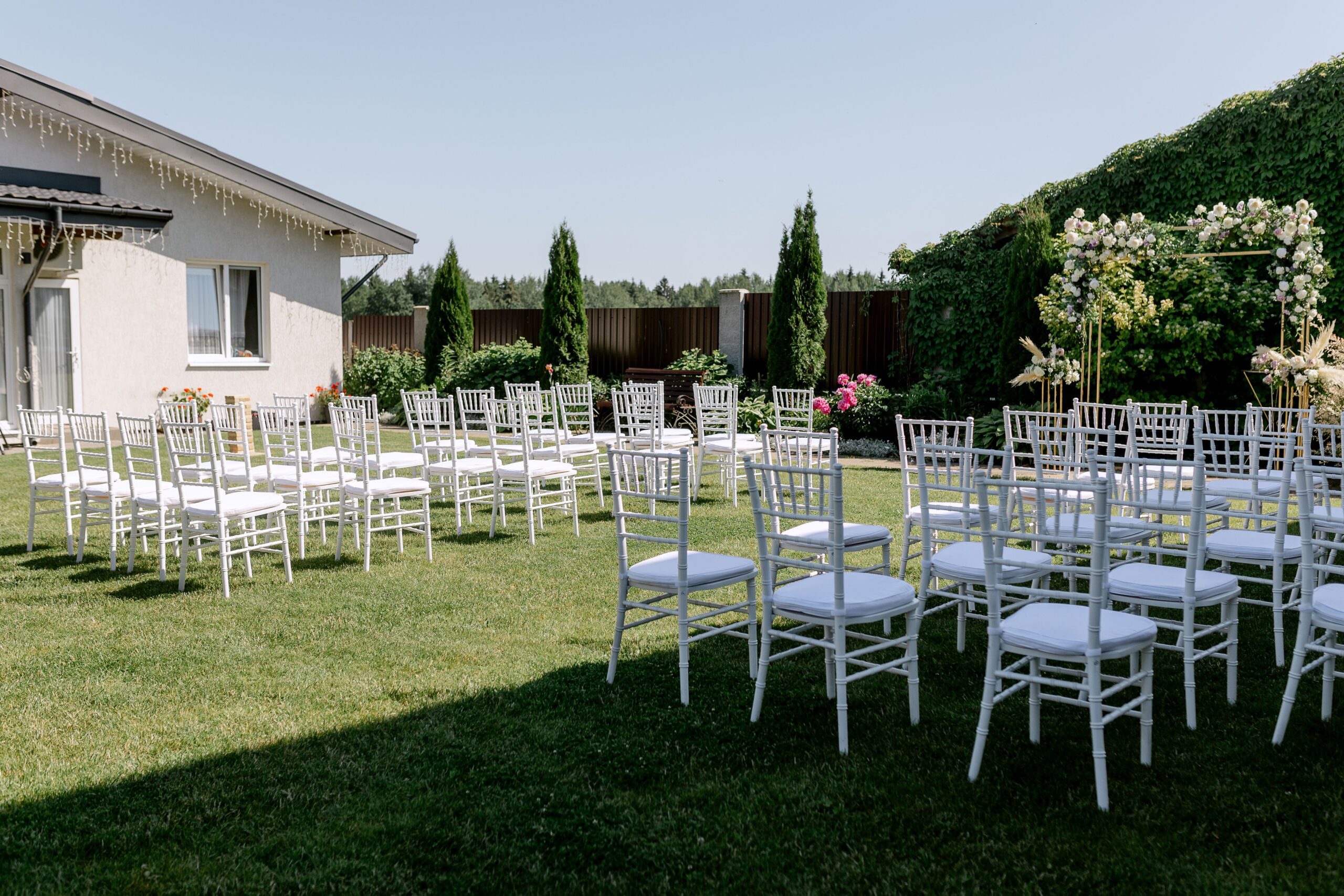
I have a soft spot for weddings on family property because I planned my own wedding that way.
My husband grew up going to his family’s property in Leakey, Texas, out in the Hill Country. It was undeveloped riverfront land, and it already meant a lot to him long before we ever decided to get married there. Getting to share a place that was such a meaningful part of his life meant a lot to me too, so the location felt personal before we added a single wedding thing to it.
It also had no running water or electricity at the time.
So when I tell couples that a backyard wedding in Houston, or really any wedding on private property, can be incredibly meaningful while also requiring some very unromantic conversations about bathrooms, power, parking, and generators, I mean that from experience.
That’s part of why I don’t think an at-home wedding needs to look like you temporarily dropped a traditional wedding venue into someone’s yard. You chose that property for a reason. The goal should be making it work well for a wedding without decorating away everything that made you want to get married there in the first place.
START WITH WHY YOU CHOSE THE PROPERTY
Before Pinterest convinces you that your backyard desperately needs a champagne wall, lounge furniture, 47 lanterns, six wooden signs, and an entire truckload of flowers, take a good look at what you already have.
Why are you getting married there?
Maybe it’s the house where you grew up. Maybe your grandparents own land where the whole family gathers. Maybe there’s a huge oak tree in the yard that you’ve loved forever, or a back porch where everyone somehow ends up sitting after every family dinner. Or maybe one of you has years of memories tied to the property, like my husband did.
That should influence how you use the space. If everyone naturally gathers on the porch, maybe that becomes cocktail hour. If there’s a beautiful open area with great evening light, we might use it for portraits. If there’s an old tree that has been part of the family property for decades, I wouldn’t immediately cover it with a giant ceremony wall just because Pinterest says you need a backdrop.
Your wedding can absolutely transform the property a little. Flowers, tables, lighting, candles, linens, and rentals can make it feel completely different for the day. I just wouldn’t start from the assumption that everything already there needs to disappear.
FIGURE OUT WHAT THE PROPERTY DOESN’T HAVE
This is where the romantic part temporarily leaves the chat.
A traditional venue usually gives you more than a pretty place to get married. There may already be bathrooms, power, parking, tables, chairs, lighting, trash removal, space for catering, and some type of weather backup. A house, backyard, ranch, or piece of family land may give you almost none of that.
Our wedding property didn’t have running water or electricity, so we had to think beyond what everything looked like. That is the biggest difference I see when couples start considering private property. You’re essentially asking a space that was never designed to host a wedding to comfortably handle dozens of people for several hours.
Walk through the property like you’re a guest who has never been there. Where do you park? How do you know where to enter? Can an older relative comfortably make it from the parking area to the ceremony? Where is the bathroom? Where does the caterer work? Once it’s dark, can people actually see how to get back to their cars?
Then look around at the normal household things you barely notice anymore. Hoses, trash cans, pool equipment, kids’ toys, cars, lawn equipment, dog bowls, grills, and storage areas can suddenly become very noticeable once thirty chairs are pointed toward them.
You do not need to renovate your property. Sometimes getting it wedding-ready really does mean moving the grill, hiding the trash cans, putting the hose away, and clearing the areas guests are actually going to use.
GIVE DIFFERENT PARTS OF THE WEDDING THEIR OWN SPACE
One large backyard can start feeling like one large backyard pretty quickly if the ceremony, drinks, dinner, cake, and dancing all happen in the same exact spot. You don’t necessarily need more decor. You probably just need to use the property better.
Maybe the ceremony happens underneath a tree, cocktails are served closer to the house, dinner is under string lights farther into the yard, and dancing happens near the patio. Those spaces might only be twenty feet apart, but moving people from one area to another gives the day a natural flow.
Furniture, florals, rugs, tables, lighting, existing landscaping, and even the direction the chairs are facing can help define those spaces without making things complicated.
I’d also leave some empty room. You really don’t have to put something in every corner because there happens to be grass there. Guests need room to move. Vendors need room to work. Your photographer needs room to photograph what’s happening without backing into somebody’s dinner plate. A little breathing room usually makes a property feel better, not unfinished.
PLANNING A BACKYARD WEDDING IN HOUSTON MEANS TAKING THE WEATHER SERIOUSLY
If you live around Houston, I probably don’t need to explain the weather to you. Still, wedding planning can make all of us a little optimistic.
“It’ll probably cool down by the ceremony.”
Maybe. I just wouldn’t base the comfort of forty people on probably.
For a warm-weather wedding, think about what your guests will physically experience. A twenty-minute outdoor ceremony sounds perfectly reasonable until everyone is dressed up, sitting in direct sun, and dealing with Houston heat and humidity.
Look at shade, airflow, cold water, fans, access to an air-conditioned space, and how long people are expected to sit outside at once. Older relatives and young children deserve some extra consideration here too. The National Weather Service Houston/Galveston regularly recommends shade, hydration, and cooling breaks during dangerous heat, which is pretty practical wedding advice too.
And remember, a tent gives you shade. It does not magically turn August into October.
If you’re renting one during a hot part of the year, ask the rental company what airflow or cooling options make sense for the size of the tent and your guest count.
Rain needs an actual plan too. “We have a tent” is a start, but what happens if the ground underneath it is soaked? Where do guests walk? Can the vendors still access their setup area? Where will family photos happen? Where do we go for couple portraits if the entire yard is muddy?
Your backup plan should be something you’d still be comfortable using. Obviously, nobody is hoping for Plan B, but Plan B shouldn’t feel like wedding punishment either.
SPEND MONEY ON THINGS PEOPLE CAN ACTUALLY FEEL
This is probably where I’m going to recommend spending money on things much less exciting than flowers.
Guest comfort is worth paying for. People notice when they’re unbearably hot, when there aren’t enough bathrooms, when the chairs are uncomfortable, when they’re walking through mud in heels, or when they need their phone flashlight just to find their car.
Nobody leaves a wedding saying, “Beautiful day, but I really wish they’d had three more acrylic signs.”
If your budget has limits, I would personally prioritize weather coverage, cooling, comfortable seating, bathrooms, food, drinks, lighting, safe walkways, and whatever infrastructure the property genuinely needs. Then choose a few visual things that actually make an impact instead of spreading the decor budget across fifty tiny things.
Lighting is one place where I think the money can go a long way. String lights over dinner tables can completely change the feel of a backyard after sunset. Candles make dinner feel warmer and more intimate. Lighting around a dance area creates atmosphere, while lights along a walkway keep somebody’s grandma from navigating the yard in the dark.
And selfishly, yes, your photographer will also appreciate good lighting. You’re getting function, atmosphere, and better conditions for photographs from the same thing. I’m a fan.
THINK ABOUT THE CEREMONY LIGHT BEFORE EVERYTHING IS SET IN STONE
Here comes the photographer part.
Please show your photographer where you’re thinking about having the ceremony before one hundred rental chairs arrive and everything becomes much harder to change.
The prettiest spot on the property at noon may look completely different at the actual ceremony time. By 5:30, one of you might be standing in direct sun while the other person is completely shaded. Your guests may be staring straight toward the sun, or the beautiful background you chose might now include every car parked along the edge of the property.
This doesn’t mean you should design the whole wedding around your photographs. I wouldn’t tell a couple to do that. It means a photographer can sometimes spot a small problem before it becomes one. Moving the ceremony direction slightly or adjusting the time can make a huge difference without changing what you actually wanted.
I’m also going to look for somewhere we can do family photographs and couple portraits. Please do not feel like you need to create a special portrait area for me. Give me decent light, enough room to fit everybody, and a relatively clean background, and I can usually work with the rest.
If you’re getting ready inside the house, choose a room with good window light if you have one and clear the obvious clutter. You absolutely do not need to deep-clean the entire house because your photographer is coming over.
I am not opening cabinets. I do not care what your laundry room looks like.
I just don’t want the getting-ready photos to include six Amazon boxes, three suitcases, somebody’s bra hanging over a chair, and a half-eaten Chick-fil-A breakfast directly behind you.
Wedding mornings get messy. We know. Give us one decent corner and we’ll be fine.
DON’T ACCIDENTALLY TURN YOUR FAMILY INTO THE WEDDING STAFF
At-home weddings make this really easy to do without realizing it. Everybody already feels comfortable at the house, so Dad is moving chairs, an aunt is directing the caterer, your sister is filling drink coolers, and Mom is trying to get dressed while somebody keeps asking her where the extension cords are.
By the time the ceremony starts, half the people closest to you have already worked a six-hour shift.
Some family involvement can be really sweet, especially when people genuinely want to help. I just wouldn’t make your family the entire infrastructure of the wedding.
If you have several vendors or an involved setup, I think coordination help is worth seriously considering. That does not necessarily mean you need some massive full-service planning package. It means someone besides you should know what is happening and be able to answer questions.
Your photographer should know where to arrive. The caterer should know where they’re setting up. Rentals should have delivery instructions. The DJ should know where power is coming from. And eventually, your family should get to stop setting up your wedding and actually be at your wedding.
GIVE YOURSELF MORE TIME THAN YOU THINK YOU NEED
An intimate wedding is not automatically a slow wedding. Sometimes couples assume that thirty guests means the day will naturally be laid-back. Meanwhile, everyone is still running around that morning because vendors are arriving, family is finishing setup, somebody is looking for scissors, and four different people need to ask the couple a question.
Home also makes it easier for people to walk in and out of your getting-ready space because, well, it’s home.
Give yourself more room in the timeline than you think you’ll need. I especially like building in a few small pieces of the day where the couple gets to disappear for a minute.
Maybe you have a private first look somewhere on the property. Maybe we take ten minutes after the ceremony before you immediately join cocktail hour. Maybe we sneak away during the reception for sunset portraits.
Yes, we’ll get good photographs during those moments. But you also get ten minutes where nobody is asking you where the napkins are. That’s a win too.
A BACKYARD WEDDING IS NOT AUTOMATICALLY THE CHEAP WEDDING
This surprises people.
Getting married at home can absolutely save money, especially if the guest list is small and the property already has most of what you need. But if you have to essentially build a temporary wedding venue from scratch, those expenses start adding up.
You may need:
– A tent
– Flooring
– Tables and chairs
– Linens and place settings
– Portable restrooms
– Fans or cooling
– A generator or additional power
– Lighting
– Catering equipment
– Insurance
– Parking or transportation
– Setup and cleanup labor
Suddenly the “free venue” isn’t quite as free as it looked.
That doesn’t mean a private-property wedding is a bad financial decision. I planned one myself, and I completely understand choosing the meaningful location even when it creates more work.
I just wouldn’t choose it solely because somebody told you backyard weddings are cheaper. Price out the whole thing. Compare it with a restaurant, private dining room, micro-wedding space, or small venue if cost is one of your biggest reasons for considering home. Then decide whether the property itself is worth the extra logistics to you.
PARKING, NEIGHBORS, NOISE, AND OTHER THINGS NOBODY PUTS ON PINTEREST
Before you commit to the property, find out what actually applies to the address.
If the wedding is within Houston city limits, the City of Houston has regulations around amplified sound, including permits and specific hours for certain types of amplified sound. Other Houston-area locations may have completely different rules.
So if the property is in Pearland, Katy, Sugar Land, The Woodlands, another municipality, or an unincorporated area, do not assume City of Houston rules apply. Check the actual jurisdiction, HOA restrictions if there are any, property agreements, insurance requirements, and anything your specific vendors need.
I’d also give the neighbors a heads-up. You don’t need to present them with a twelve-page wedding proposal, but letting them know there will be music, extra cars, and guests next door is a lot nicer than meeting them for the first time when somebody is asking the DJ to turn the music down.
Parking also deserves more thought than “people will figure it out.” Forty guests can turn into a lot of cars very quickly. If there isn’t enough room at the property, consider approved off-site parking, a shuttle, valet service, or a clear rideshare drop-off area.
You want guests thinking about your wedding when they arrive, not whether their car is about to be towed.
A QUICK AT-HOME WEDDING REALITY CHECK
Before everything gets too far along, I would make sure you can answer these:
– Where is the ceremony happening?
– Where do guests go immediately afterward?
– Where are dinner and dancing happening?
– What is the complete rain plan?
– What happens if it is extremely hot?
– Is there enough electrical capacity for the vendors?
– Is there reliable water access?
– Are there enough bathrooms?
– Where is everybody parking?
– Can older guests comfortably move around the property?
– Where will vendors work and set up?
– Where are you getting ready?
– Where can family photographs happen?
– Who answers vendor questions?
– Who is responsible for setup and cleanup?
– What rules or restrictions apply to the property?
– What parts of the property actually matter to you?
You don’t need to turn your wedding into some giant production plan. But if half of those answers are still “we’ll figure it out that day,” I would give the logistics another pass.
Especially bathrooms. Please figure out the bathrooms.
LET IT STILL FEEL LIKE HOME
This is probably my strongest opinion about at-home weddings.
Handle the logistics. Make people comfortable. Rent the bathrooms. Bring in the generator if you need one. Move the trash cans. Add flowers, lighting, tables, music, and whatever makes the wedding feel like the two of you.
But please don’t feel like you need to disguise the property until it looks like a wedding venue.
If you’re getting ready in the room you grew up in, photograph there. If everybody in the family has spent years sitting on that back porch, use the porch. If there’s a tree that has been on your grandparents’ property since your mom was little, I don’t need a giant flower wall covering it.
Those are the things I’m interested in as a photographer because they belong to your life.
That was true for me long before I became the photographer on the other side of the wedding day. My husband’s family property in Leakey wasn’t convenient because it had everything a wedding venue should have. It definitely did not. We chose it because it meant something to him, and being invited into that part of his life made it meaningful to me too.
We added another memory to a place that already had plenty of them.
If you’re planning an intimate wedding or backyard wedding in the Houston area, make it comfortable, make it work, and make it beautiful in whatever way feels like you. Just don’t accidentally remove the very thing that made getting married there special.
If you’re looking for a Houston wedding photographer who loves candid moments, meaningful places, and weddings that feel like the people actually getting married, I’d love to hear what you’re planning.






LEAVE A COMMENT
Comments